

Download game School Game [v0.980 bugfix7] [APK]
IMAGE GAME School Game [v0.980 bugfix7] [APK]
Details GameSchool Game [v0.980 bugfix7] [APK]
Developer: Sloths Command
Version: 0.980 bugfix7
Operating system: Windows, Android, Linux, Android
Update date: 27/08/2026

About Game School Game [v0.980 bugfix7] [APK]
- School Game [v0.980 bugfix7] [Sloths Command]
- School Game Review
- A Genuine School Sandbox Rather Than a Linear VN
- Character Creation Gives the Player More Ownership
- Skills Provide Long-Term Character Progression
- Perks Expand Character Builds
- Equipment Gives Money a Practical Purpose
- Reputation Is a Major Social Resource
- The Student Council Creates a Power-Progression Path
- Clubs Add More Ways to Participate in School Life
- The Sandbox Encourages Different Priorities
- Randomized NPCs Make the Academy Less Static
- NPC Generation Has Become Increasingly Detailed
- Established Characters Still Matter
- Relationships Are Part of a Larger Simulation
- Budget Management Adds Another Layer
- Freedom Can Also Make Progression More Complicated
- A Walkthrough Should Focus on Systems and Objectives
- A Student Council Guide Has Strong SEO Potential
- NPC Guides Can Address an Unusual Search Intent
- Character Builds Create Replay Value
- The Game Has a Very Long-Form Structure
- Mod Support Extends the Sandbox
- PC Is Well Suited to the Large Interface
- Android Provides Full Mobile Access
- Active Development Continues to Refine Existing Systems
- Pros
- Cons
- Final Verdict
- Explore More on GameCax
School Game [v0.980 bugfix7] [Sloths Command]
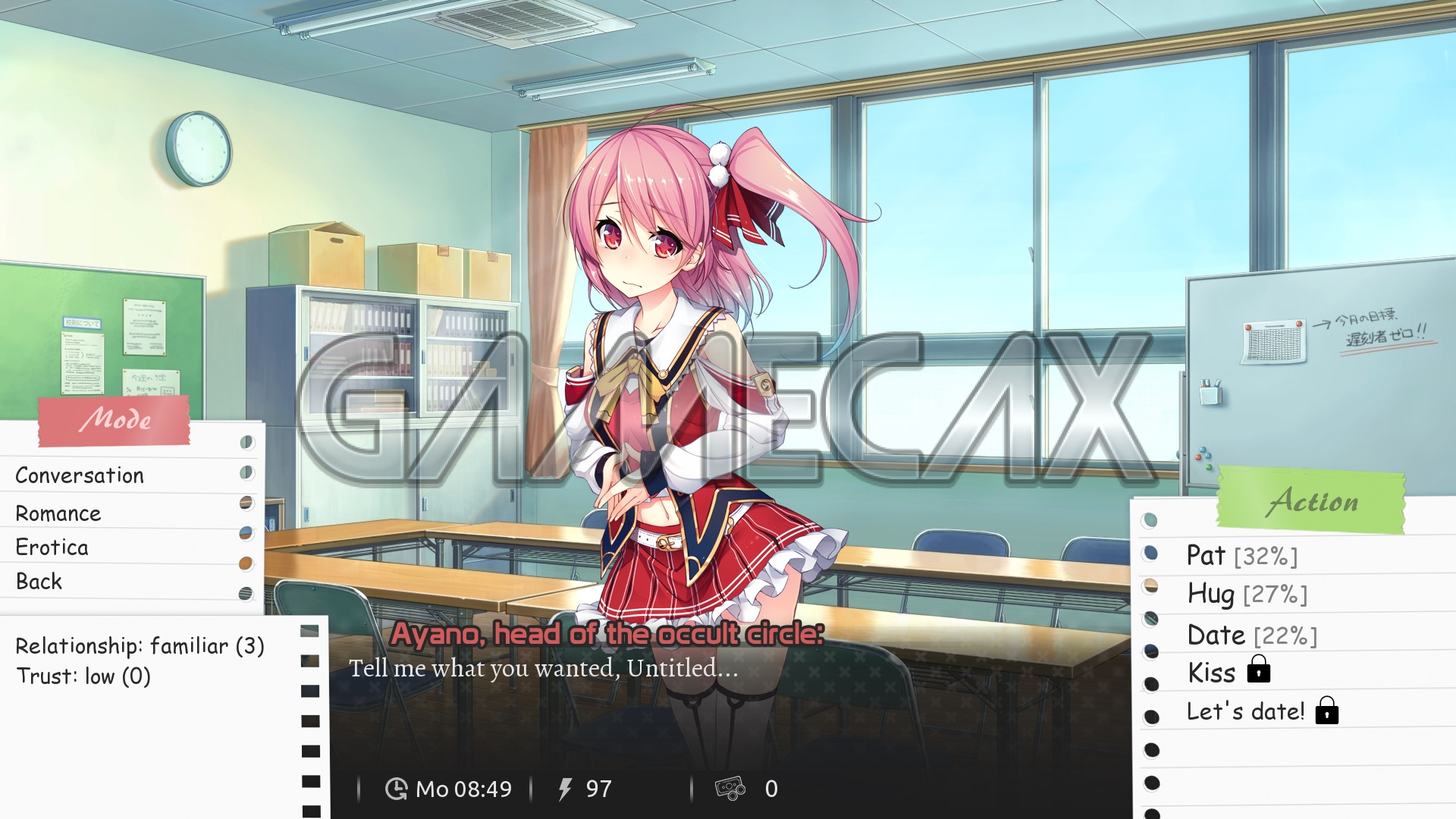
School Game is a sandbox RPG, simulation game, and visual novel developed by Sloths Command. Instead of placing the player inside a fixed story with one predetermined protagonist, the game allows you to create your own character and gradually build a life inside a large academy environment.
Freedom is central to the design. Players can develop skills, purchase equipment, manage money, meet other characters, improve their reputation, join clubs, become involved with the student council, develop relationships, and decide what kind of position they want to occupy within the academy.
This makes School Game fundamentally different from a conventional linear visual novel. Rather than progressing automatically from one story scene to another, the player determines which systems, characters, activities, and objectives receive attention.
Character creation provides the starting point for this sandbox structure. The protagonist can be customized before entering the wider school environment, while later progression continues through skills, perks, equipment, relationships, reputation, and other character-development systems.
The student council is one of the most distinctive parts of the game’s social progression. Players can become involved with the organization, improve their relationship with its president, influence their standing within the academy, and potentially pursue greater authority rather than remaining an ordinary student throughout the entire playthrough.
Clubs provide another way to become involved in school life. Different organizations and activities create additional opportunities for progression while helping the academy function as more than a collection of character scenes.
School Game also features randomized NPC systems alongside its established characters. These dynamically generated students can have their own appearances and background information, increasing the number of people the player can encounter without requiring every NPC to be permanently predefined.
As development has continued, Sloths Command has expanded these procedural systems substantially. Randomized NPCs can contain more detailed biographies, visual variation, and additional behavioral information, making the wider academy population an important part of the sandbox rather than simple background decoration.
Money and equipment are integrated into character progression. Players can build their budget, purchase useful items, and make decisions about where resources should be spent rather than treating currency as an irrelevant statistic.
Because School Game contains many interacting systems, a successful playthrough is less about finding one universally correct route and more about deciding what kind of character you want to create. Reputation, relationships, skills, organizations, money, and personal priorities can all shape how you approach the academy.
The project remains under active development, so this page focuses on the permanent School Game experience, including character creation, sandbox freedom, skills, reputation, clubs, student council progression, NPCs, equipment, and social systems rather than content associated with any individual release.
School Game is available for both desktop and Android players. You can browse more Windows Adult Games or explore additional Android Adult Games available on GameCax.
School Game Review
A Genuine School Sandbox Rather Than a Linear VN
The defining characteristic of School Game is freedom. Sloths Command does not ask every player to follow exactly the same sequence of character events from beginning to end.
Instead, the academy functions as a framework containing progression systems, social opportunities, organizations, characters, resources, and activities. Players decide which parts of that framework matter most to their own playthrough.
Character Creation Gives the Player More Ownership
Creating the protagonist immediately distinguishes School Game from visual novels built around a completely predefined lead character. The player begins by shaping the character who will participate in the wider simulation.
This approach fits naturally with a sandbox RPG because the protagonist is intended to develop according to the player’s priorities rather than simply reveal a personality that was already fully determined by the developer.
Skills Provide Long-Term Character Progression
Learning and improving skills gives everyday progression a mechanical purpose. The protagonist is not static throughout the experience and can become more capable as the player invests time in particular areas.
This gives players another reason to plan how they spend their time instead of moving exclusively from one relationship event to another.
Perks Expand Character Builds
School Game’s broader development plans include a substantial perk system designed to add more variation to individual characters. Perks can help differentiate one playthrough from another by allowing different strengths and behavioral possibilities.
This reinforces the RPG side of the experience because character development involves more than simply increasing one universal relationship score.
Equipment Gives Money a Practical Purpose
Players can purchase equipment rather than accumulating money without anything meaningful to spend it on. This creates another connection between the game’s economic and character-development systems.
Choosing when to save and when to invest becomes part of progression, particularly when several other activities are competing for the player’s resources.
Reputation Is a Major Social Resource
School Game places considerable emphasis on reputation. The protagonist’s standing within the academy can influence how their broader school life develops and provides a measurable representation of social progression.
This is especially appropriate for a game centered on student organizations, clubs, relationships, and political influence within the school environment.
The Student Council Creates a Power-Progression Path
One of School Game’s more unusual systems is the ability to become deeply involved with the student council. Instead of functioning only as another group of characters, the organization creates opportunities for the protagonist to gain influence.
The relationship with the student council president is particularly important, and the player may eventually pursue enough power to challenge the existing leadership rather than permanently remaining subordinate to it.
Clubs Add More Ways to Participate in School Life
Various clubs provide additional activities and social structures outside the student council. These organizations help create a sense that the academy contains several overlapping communities rather than one central storyline surrounded by unrelated characters.
Choosing which groups deserve attention can become part of the player’s broader progression strategy.
The Sandbox Encourages Different Priorities
Some players may concentrate heavily on relationships, while others may prioritize reputation, money, skills, organizations, or character development. School Game’s design intentionally allows these different priorities to coexist.
This flexibility gives the game stronger replay potential because another playthrough does not need to follow exactly the same strategy.
Randomized NPCs Make the Academy Less Static
Procedurally generated NPCs are one of the systems that most clearly separate School Game from a traditional visual novel. The school population is not limited exclusively to a small cast of permanently predefined characters.
Randomized students introduce more variety into everyday interactions and make the academy feel less like a fixed collection of scripted scenes.
NPC Generation Has Become Increasingly Detailed
Sloths Command has continued investing in the randomized character system rather than treating these NPCs as disposable extras. Generated characters can have visual variations and increasingly detailed personal information.
The addition of larger biography systems gives them more context and supports the developer’s broader goal of making the sandbox feel populated by individuals rather than identical placeholders.
Established Characters Still Matter
Procedural characters do not completely replace authored story content. Important established characters and relationships remain major parts of progression, giving the game a balance between repeatable sandbox systems and more deliberately written interactions.
This combination can provide more variety than relying entirely on either predefined routes or random generation alone.
Relationships Are Part of a Larger Simulation
Relationship progression does not exist in isolation from the rest of School Game. The protagonist is simultaneously managing skills, reputation, money, organizations, equipment, and their position within the academy.
This gives social progression more context because relationships develop inside a broader character-building experience.
Budget Management Adds Another Layer
The player’s budget influences what can be purchased and how quickly particular areas of character development can progress. Money therefore acts as another resource that needs to be managed alongside social and skill progression.
The system is relatively straightforward, but it helps reinforce the simulation aspect of the game.
Freedom Can Also Make Progression More Complicated
The obvious trade-off for having many systems is that players can occasionally become uncertain about what they should prioritize next. A linear visual novel always knows exactly which scene follows the current one, while School Game deliberately gives the player more possibilities.
This creates genuine demand for walkthroughs and system guides rather than walkthrough content existing only for SEO purposes.
A Walkthrough Should Focus on Systems and Objectives
A useful School Game walkthrough should explain how to develop the protagonist efficiently, improve reputation, progress important characters, use organizations, manage money, and understand the requirements behind major objectives.
A simple list of dialogue choices would ignore most of the systems that distinguish the game from a conventional visual novel.
A Student Council Guide Has Strong SEO Potential
The student council is sufficiently important to justify dedicated guide content. Players may want to know how to join, how to improve their standing, how to progress the council president’s storyline, and what conditions influence greater political control.
This provides a much stronger supporting topic than a generic article about visual-novel choices.
NPC Guides Can Address an Unusual Search Intent
The randomized NPC system creates another category of questions that most visual novels do not have. Players may need to understand how generated characters work, what information is persistent, how their traits differ, and which systems influence interactions with them.
A dedicated NPC guide could therefore become useful supporting content as these procedural systems continue expanding.
Character Builds Create Replay Value
Skills, perks, reputation, equipment, and social priorities allow another playthrough to develop differently from the first. A player can concentrate on other abilities or organizations rather than repeating the exact same development path.
This creates replay value through systems instead of relying exclusively on mutually exclusive romantic endings.
The Game Has a Very Long-Form Structure
The official distribution describes average sessions in terms of days rather than short play sessions, which fits the size of the simulation. School Game is designed as an environment in which numerous systems and relationships gradually develop rather than a short narrative experience.
Players interested in quickly completing one fixed story may therefore find the sandbox considerably larger than expected.
Mod Support Extends the Sandbox
School Game officially supports modifications, allowing additional files to be installed into a dedicated modifications folder. This provides another way for the community to expand or alter the experience beyond the developer’s standard content.
Players using mods should nevertheless remember that custom scripts can complicate troubleshooting when the underlying game changes.
PC Is Well Suited to the Large Interface
The desktop release provides a comfortable way to manage the game’s large number of systems, menus, characters, and long-term progression. Players who spend significant time working with sandbox mechanics may find a larger display particularly convenient.
Android Provides Full Mobile Access
School Game is also officially distributed for Android. Touchscreen support fits the menu-driven nature of the simulation, allowing mobile players to manage relationships, progression systems, equipment, and other activities without requiring real-time action controls.
Mobile users should use the Android package specifically designed for their device rather than attempting to run the desktop release directly.
Active Development Continues to Refine Existing Systems
Sloths Command continues to spend significant development time not only adding content but also refactoring code, fixing bugs, and improving existing mechanics. This is particularly important for a sandbox containing many interconnected systems.
The disadvantage is that old guides can gradually become inaccurate when major mechanics or progression logic are redesigned.
Pros
- Extensive freedom compared with linear visual novels.
- Custom character creation.
- RPG-style skill and character progression.
- Equipment and budget systems give resources practical value.
- Reputation provides meaningful social progression.
- Student council offers an unusual power and influence path.
- Multiple clubs expand school-life activities.
- Large sandbox supports different play styles.
- Randomized NPCs make the academy population more dynamic.
- Procedural biography systems add depth to generated characters.
- Strong potential for system-focused guides and walkthroughs.
- Mod support extends the base experience.
- Official desktop and Android releases.
- Continued refactoring and mechanic improvements during development.
Cons
- The large number of systems can overwhelm new players.
- Progression is less obvious than in a linear visual novel.
- Players may need guides to understand specific mechanics efficiently.
- Sandbox freedom can create periods where the next useful objective is unclear.
- Procedural systems may feel less tightly authored than major character storylines.
- Large mechanical changes can make older walkthroughs inaccurate.
- Mods can complicate troubleshooting after updates.
- The overarching project remains under active development.
Final Verdict
School Game is best understood as a large school-life sandbox with RPG and simulation systems rather than a traditional visual novel. Sloths Command gives players control over character creation, skills, equipment, money, reputation, relationships, clubs, student council involvement, and numerous other aspects of the protagonist’s academy life.
The student council and randomized NPC systems are particularly important to the game’s identity. One provides an authored path toward greater influence inside the academy, while the other makes the surrounding population more dynamic than a completely fixed cast would allow.
This freedom comes with additional complexity. School Game expects players to understand several overlapping systems, and the best progression strategy depends on what kind of character and school life they want to build. That makes system guides considerably more valuable than a conventional choice-by-choice visual-novel walkthrough.
The long development cycle has also allowed Sloths Command to expand and refactor many of these systems, including increasingly sophisticated randomized NPC generation. The result is a project whose depth comes primarily from interacting mechanics and player freedom rather than one tightly controlled narrative route.
For players who enjoy character creation, sandbox progression, school simulations, reputation systems, organizations, and the freedom to pursue different objectives at their own pace, School Game offers substantially more mechanical depth than its simple title initially suggests.
| Category | Score |
|---|---|
| Sandbox Freedom | 9.4 / 10 |
| Character Progression | 9.1 / 10 |
| Social Systems | 9.1 / 10 |
| Student Council & Clubs | 9.2 / 10 |
| NPC Systems | 9.2 / 10 |
| RPG & Simulation Depth | 9.2 / 10 |
| Accessibility | 8.5 / 10 |
| Content Depth | 9.4 / 10 |
| Overall | 9.2 / 10 |
Explore More on GameCax
Explore More Sandbox RPG and Simulation Games
If you enjoy School Game, GameCax features more adult games that combine character development, relationships, RPG progression, and sandbox freedom. These games give players greater control over how they spend their time and which objectives they want to pursue instead of forcing every playthrough through exactly the same sequence of events.
Decide What Kind of Character You Want to Build
School Game offers several overlapping progression systems, including skills, reputation, equipment, money, relationships, clubs, and school organizations. Establishing a few priorities early can make progression easier than attempting to develop every system simultaneously.
Pay Attention to Reputation and Social Progression
Reputation is an important part of life inside the academy. Improving your social standing can complement character relationships and organizational progression, so it should be treated as a meaningful resource rather than an isolated statistic.
Explore the Student Council and Clubs
School organizations provide some of the most distinctive progression opportunities in School Game. The student council offers a path toward greater influence within the academy, while clubs provide additional activities and social opportunities beyond ordinary character interactions.
Experiment With Randomized NPCs
The academy contains dynamically generated students alongside established characters. These NPCs help make individual playthroughs less predictable and expand the social sandbox beyond a small fixed cast.
Keep Multiple Saves While Exploring the Sandbox
Because School Game allows players to pursue different objectives and character-development strategies, maintaining several manual saves is useful. Separate saves make it easier to experiment with another progression path or return to an earlier point without restarting the entire sandbox.
Discover More PC and Android Games
School Game is available for desktop and mobile players. You can browse more Windows Adult Games or explore additional Android Adult Games available on GameCax.
Image Game School Game [v0.980 bugfix7] [APK]
Other Information Game School Game [v0.980 bugfix7] [APK]
FAQ:
Installation:
ChangeLog:
Note:
Video Game School Game [v0.980 bugfix7] [APK]
There are currently no YouTube videos for this game.
Link Download Game School Game [v0.980 bugfix7] [APK]
Comment game School Game [v0.980 bugfix7] [APK]